.png)
Industrial Water Treatment Plant in Dubai, UAE


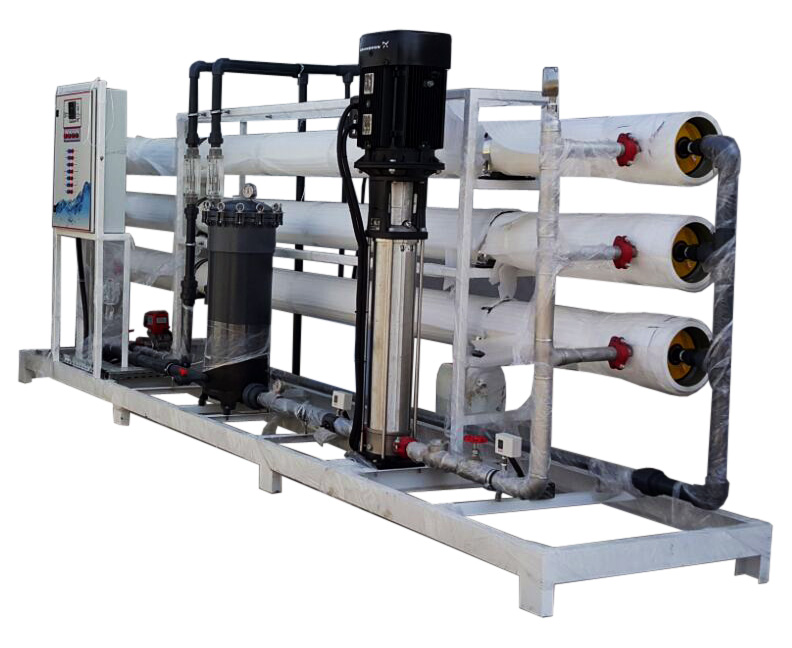
Industrial Water Treatment Plant in Dubai, UAE
INDUSTRIAL REVERSE OSMOSIS (RO) SYSTEMS
Reverse Osmosis is a technology that is used to remove a large majority of contaminants from water by pushing the water under pressure through a semi-permeable membrane. Reverse osmosis membrane technology for industrial applications. Reverse osmosis (RO) systems from Evoqua Water Technologies offer a cost-effective and sustainable solution for water, wastewater and reuse applications. The most important factor in treating industrial wastewater with Reverse Osmosis (RO) is the pretreatment that protects the membrane against organic fouling, mineral scaling, and chemical degradation.
Before reverse osmosis should be considered, a complete cation/anion balance is required and potential foulants must be identified. High BOD and COD levels can also contribute to membrane fouling. The effluent discharged to the sewer typically contains between 100 to 40,000 parts per million (ppm) total dissolved solids (TDS). With the proper pretreatment technology followed by RO, this water can be recycled. Ion exchange treatment of the RO product water can further polish the water and make it suitable for all rinses.
To design a successful and cost-effective system, Evoqua evaluates each individual application because the pH, oxidizing potential and concentration of soluble salts of the wastewater effluents often exceed the operating limits of the RO systems. After the detailed evaluation of the wastewater is complete, Evoqua determines the optimum preconditioning chemistry and selects the best pretreatment technology for the application.
What is Reverse Osmosis?
Reverse Osmosis / RO is a technology used to remove dissolved solids and impurities from water using a semi-permeable RO membrane which allows the passage of water but leaves the majority of dissolved solids and other contaminants behind. The RO membranes require water to be under high pressure (greater than osmotic pressure) to do this. The water that passes through the RO membrane is referred to as the "permeate" and the dissolved salts that are rejected by the RO membrane is referred to as the "concentrate". A properly run RO system can remove up to 99.5% of incoming dissolved salts and impurities.
How does Reverse Osmosis work?
Reverse Osmosis works by using a high pressure pump to increase the pressure on the salt side of the RO and force the water across the semi-permeable RO membrane, leaving almost all (around 95% to 99%) of dissolved salts behind in the reject stream. The amount of pressure required depends on the salt concentration of the feed water. The more concentrated the feed water, the more pressure is required to overcome the osmotic pressure.
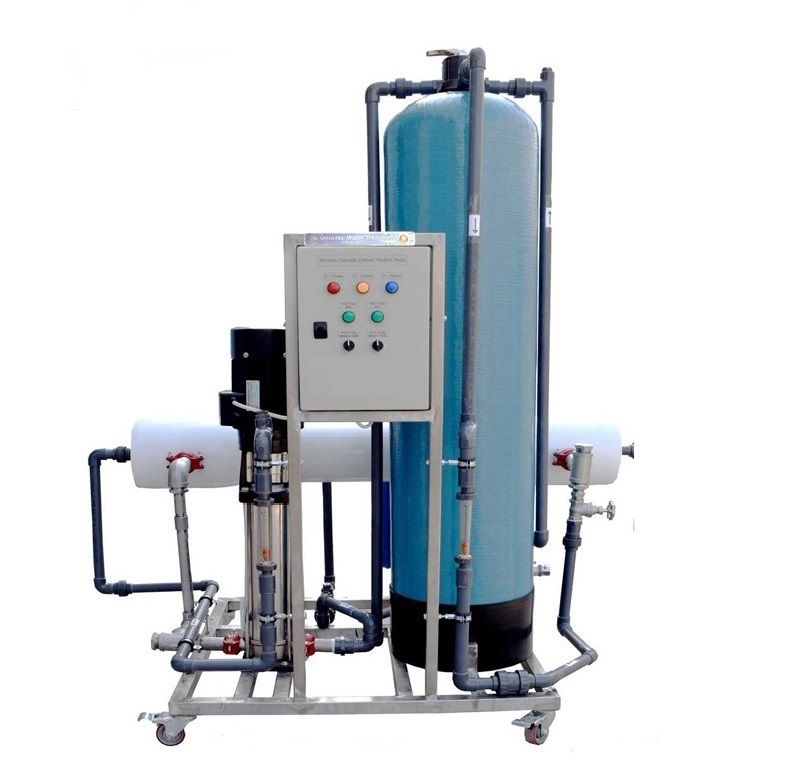
Features of Reverse Osmosis Systems:
- Capacities from 1500 to 250,000 gallons per day and above – suit a wide variety of applications
- Spiral wound, thin film composite membranes – provide superior salt rejection and product flow at low operating pressures.
- Computerized system design – accurately projects system operating characteristics for each application.
- Multistage centrifugal pumps – stainless steel wetted parts for corrosion resistance and offer quiet, high efficiency operation.
- Cartridge pre-filter – all polypropylene or stainless steel for corrosion control, 1 micron filter elements included for better membrane protection
Replaceable lamps AquaPro UV-12-L (USA) have a long service life and high efficiency. The performance of each AquaPro UV-12GPM-L (UV-12-L) lamp is checked by VODOEXPERT before being handed over / sent to the client. The frequency of lamp replacement is once a year with continuous operation, or after 9000 hours with periodic switching on and off of the UV sterilizer.
UV sterilizer compatibility:-
- Control Panel - NEMA 4 control panels include digital conductivity and flowmeters, programmable controller PLC, touchscreen display, fuses, motor starter and control transformer.
- Control systems – adaptable to suit customer specifications.
- Control Valves – pump and reject throttle valves are included for flow and pressure control.
- Automatic Flush – permeate or feed water flush system (AFS) reduces corrosion potential and membrane fouling. Permeate flush can extend membrane cleaning frequency and membrane life.
- Liquid filled pressure gauges – liquid filled gauges assure pulse free readings and long gauge life.
- Flowmeters – in-line and/or paddlewheel to PLC offer consistent accuracy and corrosion free performance.
- Convenient layout – all gauges, meters and controls are located next to the control panel for ease of operation
- Feed water control valve – automatically shuts off feed water when system is not operating.
- Low pressure switch – protects the pump from damage caused by inadequate pump inlet pressure.
- High pressure switch – protects the 8” membranes from high membrane feed pressure.
- Standardized system design – allows for quick shipments yet adaptable to suit individual application requirements.
- Design for expandability – systems can be expanded to meet future requirements.